
Note: These are my personal views only and do not constitute investment advice. See full disclaimer below.
Audio embedded below.
Within five days of each other in late March and early April 2026, Athora completed its £5.7bn acquisition of Pension Insurance Corporation (PIC) and Brookfield Wealth Solutions closed its £2.4bn takeover of Just Group. Two of the UK’s six established bulk purchase annuity (BPA) writers have passed into the hands of North American asset managers backed by Apollo and Brookfield respectively.
The instinctive reaction from some public equity investors that I have spoken to has been to ask whether this marks the beginning of the end for the listed players. If global asset managers with deep pockets and proprietary investment capabilities are acquiring BPA platforms, the fear runs, then Legal & General, Aviva and Standard Life will eventually be outcompeted on pricing, squeezed on margins and left behind.
I do not think that is the right conclusion, and this article sets out why. The market is too large, the pipeline too deep and the regulatory constraints too binding for private capital simply to displace the incumbents. What these deals do change, however, is the nature and intensity of competition in a market that was already becoming more demanding.
Indeed, one of the less obvious consequences may be positive for the listed players. If stronger competition slows the relentless reinvestment of capital into new BPA business, more of the cash generated by mature back books may finally reach shareholders through dividends and buybacks. Ironically, the arrival of private capital may help impose exactly the capital discipline public equity investors have long wanted to see.
For what it is worth, I have been writing for over a decade, first at RBC Capital Markets and now through this newsletter, that UK bulk annuities represent the best structural growth opportunity in European insurance. These transactions confirm that assessment rather than challenge it.

Announced last summer, real this month
When Brookfield first signalled interest in Just Group in the summer of 2025, it looked like an opportunistic bid for a company that had long traded at a large discount to book value.
The logic at the time was clear enough. The attraction was not the reported earnings, which are often volatile and misunderstood, but rather the combination of long-duration liabilities and the asset base that sits behind them. Brookfield offered 220p per share, a 75% premium to Just Group’s undisturbed price, valuing the company at £2.4bn or roughly 1.1x own funds.
What has changed since then is the number of players reaching the same conclusion. Athora’s separate £5.7bn acquisition of PIC, with Apollo providing asset management capabilities, followed a similar logic at a much larger scale. In addition, Legal & General entered a strategic partnership with Blackstone covering up to $20bn of asset origination. What looked like an opportunistic bid in isolation now looks like a repeatable strategy being pursued simultaneously by several of the world’s largest alternative asset managers.
Why asset managers see what equity investors missed
Bulk annuities are typically described as an insurance product, but that framing obscures the economics that actually matter. A bulk annuity is a transaction where an insurer takes on the pension liabilities of an entire defined benefit (DB) scheme: a scheme where the employer guarantees a specific retirement income, regardless of investment performance, in a single transaction.
Each transaction brings with it a large pool of long-term assets that need to be invested for decades. The liabilities effectively lock those assets in place. The economics of the business are therefore driven not just by the underwriting margin at the point of sale, but by the returns generated on those assets over time. Just Group alone manages £30bn of pension savings; PIC had roughly £55bn of assets at the end of 2025.
That is why this market looks different through the lens of a global asset manager. The BPA business, viewed properly, is a long-duration, predictable, captive asset management opportunity with the insurance wrapper serving primarily as the mechanism that locks in the capital. The liabilities bring the assets, and the assets drive the returns.

The US private credit playbook does not work here
There is a tendency to view this through the prism of US private credit concerns, but that is the wrong starting point. Only last week, Jamie Dimon warned that losses in private credit may prove higher than markets currently expect when the cycle turns, reflecting what he sees as weaker underwriting standards and overly optimistic assumptions.
That builds on his now famous “cockroach” warning last year, when he cautioned that “when you see one cockroach, there are probably more.” Those concerns may prove justified in parts of the US market. However, applying that same narrative directly to UK bulk annuities is overly simplistic.
The UK regulatory framework, particularly the matching adjustment (MA) regime (which allows insurers to recognise the illiquidity premium on assets backing long-term annuity liabilities), imposes clear constraints on what can be done. Assets in the MA portfolio must have fixed or predictable cashflows, must be held to maturity, in practice are often denominated in the same currency as the liabilities, and must be assigned a credit rating. The PRA sets the rules to determine the fundamental spread for each asset, which represents the compensation for expected default and downgrade risk that the insurer cannot book as MA benefit. UK BPA assets are predominantly investment grade fixed income and secured lending, not the leveraged credit and CLO structures that dominate US private credit concerns.
That means equities, hedge funds, leveraged credit and actively traded portfolios are all ineligible. Moving down the credit spectrum does not help as much as you might think, because the fundamental spread deduction claws back some of the compensation for taking more credit risk. Offshore or unrated assets require internal model approval from the PRA and face close scrutiny. The regime is deliberately designed to prevent insurers from reaching for yield at the expense of policyholder security.
Investors cannot simply increase risk to increase returns in this market. The PRA has been tightening its scrutiny of funded reinsurance arrangements throughout 2025, and the Life Insurance Stress Test (LIST) results published in November 2025 provided the market with the most granular view yet of insurer resilience under severe stress scenarios.
What the new owners can genuinely bring
If the US private credit playbook is constrained, the question becomes: what can Brookfield, Apollo and Blackstone actually do within the MA framework that the listed players currently cannot?
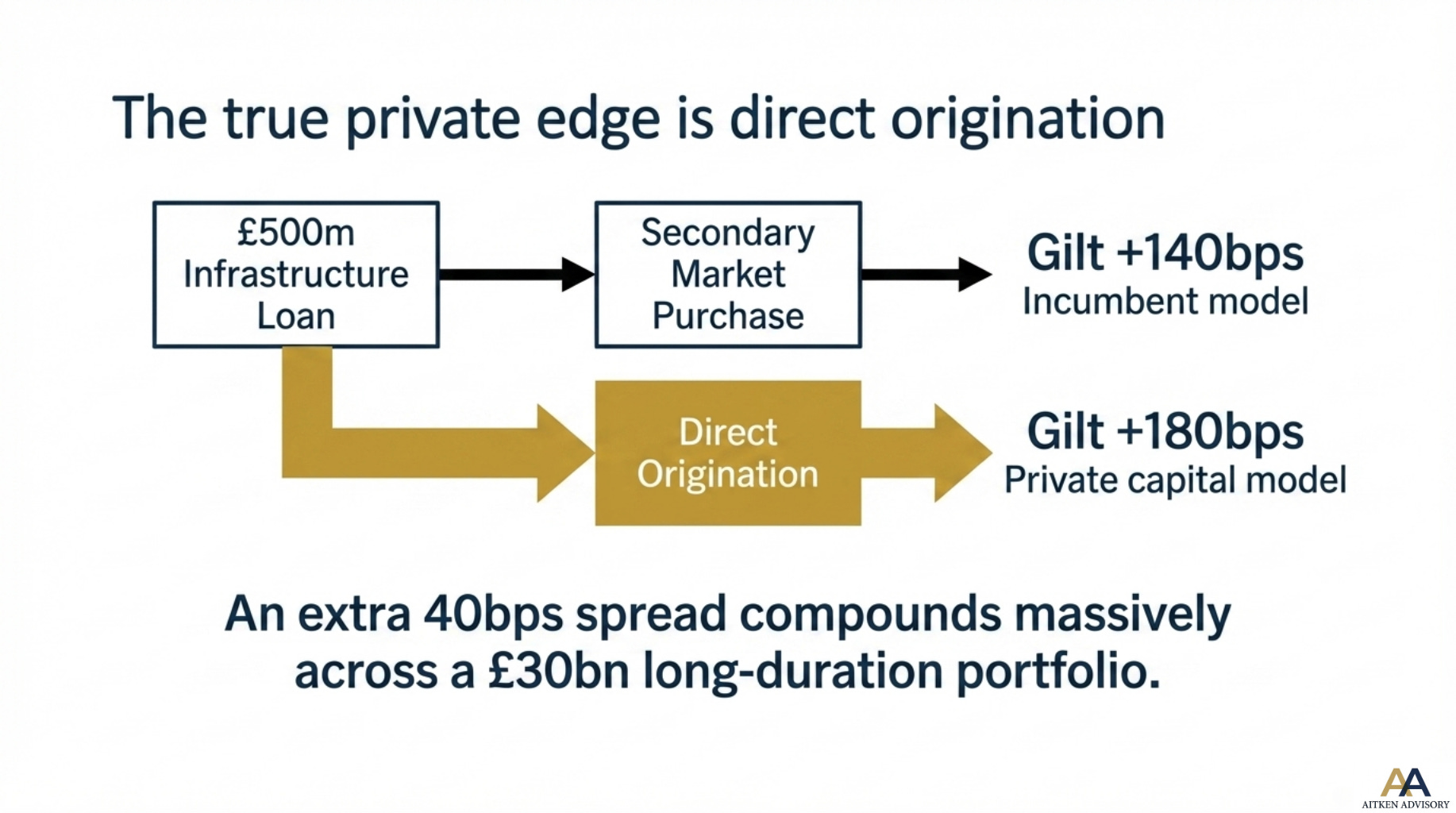
The answer is narrower than the headlines suggest, but it is real. The primary edge sits in direct origination of MA-eligible assets at wider spreads than are available in public markets. These firms see thousands of private transactions a year across their global platforms. They can source infrastructure debt, social housing loans, private placements, and secured lending directly, cutting out intermediary margins and capturing the full illiquidity premium.
I would estimate that a Brookfield or Apollo can originate a £500m infrastructure loan at gilt +180bps that a listed insurer might have to buy in the secondary market at closer to gilt +140bps. That differential may not sound dramatic, but over a £30bn asset portfolio, an additional 40bps of annual spread compounds into meaningful value over decades. The primary premium reflects illiquidity and the value of originating and structuring assets, with additional variation driven by complexity, execution certainty and market conditions.
They can also manufacture structured assets tailored to the liability profile. Taking pools of receivables, loans, or infrastructure cashflows and restructuring them into MA-eligible fixed cashflow securities is a form of asset engineering that plays directly to their skillset.
The PRA’s Solvency UK reforms (PS10/24) expanded the range of eligible assets, most notably by allowing assets with highly predictable, rather than strictly fixed, cash flows, enabling greater use of infrastructure and private credit investments.
Beyond origination, they also bring a broader global sourcing network. That can be an advantage because UK annuity writers need large volumes of long-dated assets, while the domestic sterling market is not deep enough on its own. Access to North America, Asia-Pacific and other markets widens the opportunity set. The benefit, however, depends on how efficiently those assets can be hedged back into sterling and structured to qualify for matching adjustment treatment. Where that can be done well, it may improve cashflow matching and reduce the drag from holding lower-yielding assets.
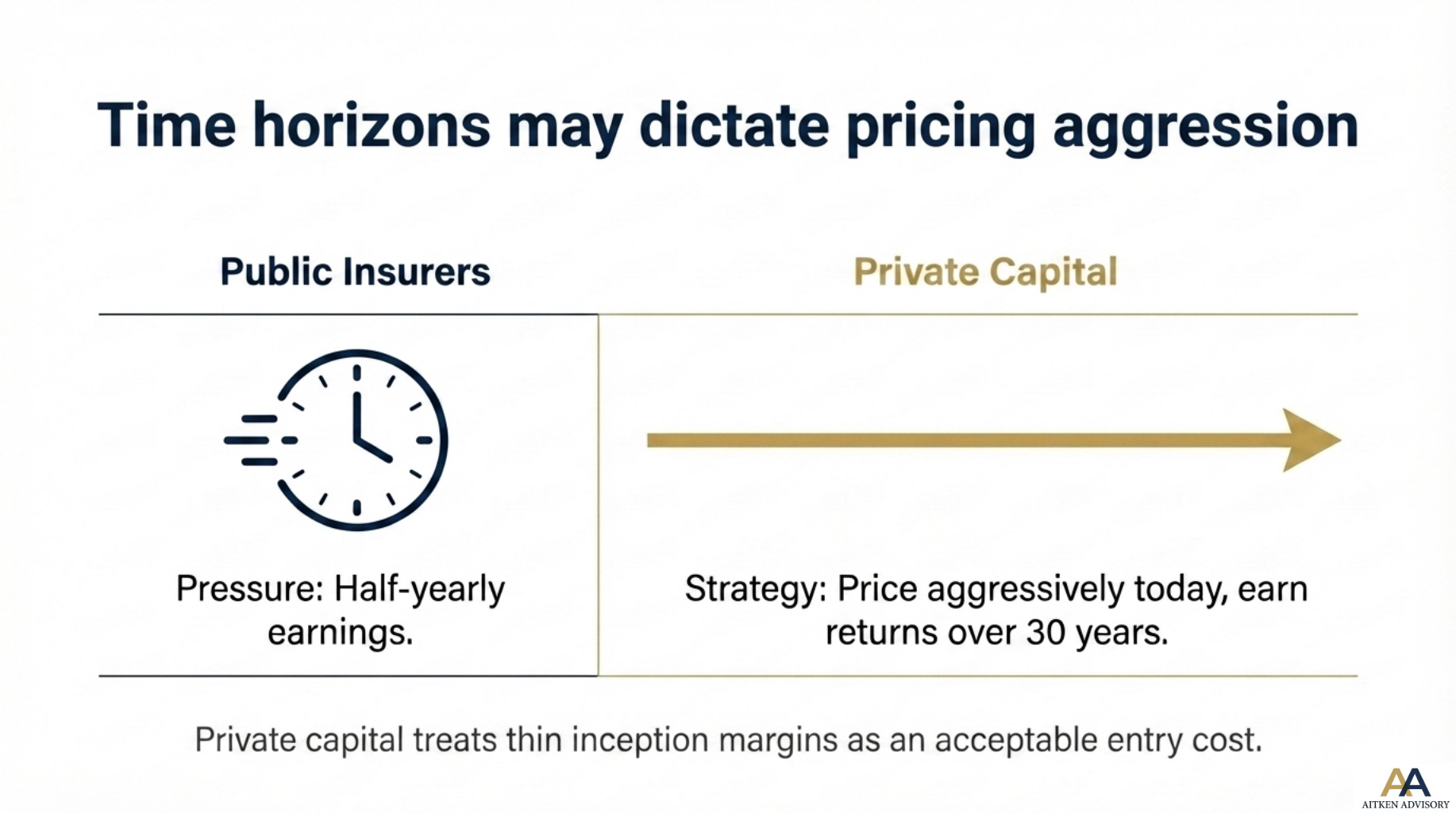
Finally, there is the question of patience. These are firms with deep pockets and long time horizons. They can afford to price new BPA business aggressively in the short term, accepting thinner underwriting margins at inception, because they expect to earn the return on the asset side over 20 to 30 years. A listed insurer with half-yearly earnings pressure cannot easily do this.
The honest assessment is that the edge is real but incremental rather than transformational. The existing asset portfolios were built under the previous ownership, and the new owners’ advantage kicks in gradually as new business is written and sourced through their platforms. Over time, as the back book rolls off and the new book grows, the asset mix shifts. The competitive impact is a slow burn, not a step change, which is another reason the listed players have time to respond.
New owners, same platforms
It is important to be clear about what these transactions represent.
The buyers are not building insurers from scratch; they are acquiring established UK platforms with existing teams, systems and regulatory approvals. PIC has been writing BPA business since 2006 and has over 400,000 policyholders. Just Group has over 700,000 customers and a well-established position in both the BPA and individual annuity markets.
From a trustee perspective, very little changes on day one. The same entities are writing business, and the same capabilities are in place. What changes is how those platforms are used, because the asset strategy behind the same underwriting capability can be very different under new ownership. Brookfield’s plan to merge Just Group with its UK subsidiary Blumont Annuity Company and run the combined entity under the Just brand tells you where the strategic emphasis sits.
Will trustees trust the new owners?
There is a question that the market data will not answer, and it is one I think matters: how will pension fund trustees respond to North American-owned counterparties?
I have seen this dynamic before. When I was at Standard Life in the mid-2000s, there was a real concern that US insurers such as AIG and Hartford would enter the UK market with variable annuity products offering generous guarantees. These products, which combined equity exposure with downside protection or income guarantees, appeared highly competitive and were seen as a potential threat to UK incumbents.
However, the financial crisis exposed the true cost of these guarantees. Hedging strategies proved far more expensive and less reliable than expected, leading to significant losses. US insurers retrenched, and the anticipated wave of guaranteed products in the UK never materialised. In my experience, the US entrants of that era left little lasting mark on the market.
The situation today is different in important respects. Brookfield and Apollo are not launching untested platforms; they are acquiring established UK businesses with long track records, PRA-regulated balance sheets, and hundreds of thousands of existing policyholders. The management teams, the regulatory capital, and the operational infrastructure all remain in place.
That said, I expect the listed incumbents to use the change of ownership as a competitive point in trustee pitches. Trustees are inherently conservative, pension consultant recommendations carry significant weight, and the message that “we remain UK-listed, UK-regulated, and accountable to public shareholders” will resonate with some decision-makers. Whether that concern is fully rational is beside the point; it is real, and it will affect how business is allocated, at least in the near term.
The new owners will need to earn trust through execution, consistency, and visible commitment to the UK market over a period of years. That is achievable, but it is not automatic.
£350bn to £550bn over the next decade
The natural assumption is that more players means more competition for a fixed pool of business, but the numbers tell a different story.
According to Hymans Robertson, 370 buy-ins were completed in 2025, a record and up from 307 in 2024. Total volumes were £38.2bn, down from £47.8bn in 2024 and below the 2023 peak of £49.1bn. That reflected not just a shift towards smaller transactions, but also the impact of higher interest rates, which reduce the premium required to insure a given set of liabilities. Of the 370 buy-ins completed in 2025, 307 were £100m or smaller. The largest transaction of the year was Legal & General’s £4.6bn buy-in for the Ford pension scheme.
Looking ahead, LCP forecasts BPA volumes of £40bn to £55bn in 2026, with record volumes possible if current pricing conditions persist. Willis Towers Watson (WTW) goes further, projecting total pension risk transfer volumes of £70bn in 2026 (including longevity swaps), with the BPA component alone expected to exceed £50bn.
The pipeline behind these numbers is substantial. UK DB pension schemes held £1.137tn of assets at end March 2026, against liabilities of £931bn, implying an aggregate surplus of around £206bn and a funding ratio of 122%, according to XPS.
In addition, the Pensions Regulator estimates that 54% of DB schemes are now funded at or above buyout level, creating a growing pool of schemes that can afford to transact.
Looking further out, LCP projects cumulative BPA volumes of £350bn to £550bn over the next decade. To put that in context, total cumulative volumes since the BPA market began only crossed the £300bn mark at the end of 2025. The next decade could see the entire history of the market repeated, and then some.
For many years, the limiting factor has been insurer capacity rather than demand. In that context, the arrival of new capital is not simply displacing existing players but increasing the system’s ability to transact.
More competitive at the small end, still concentrated at the top
Competition increased through 2025, with a record 370 buy-ins completed during the year and transaction numbers rising by more than 20%, driven mainly by deals below £100m. The data suggest that competition is broadening in the small and mid-market segments, with more insurers participating below £100m and many sharpening their small-scheme propositions. Aviva, Just and L&G together accounted for around 71% of all transactions by number, while M&G, Royal London and Utmost also continued to build their presence in the market, according to Hymans Robertson.
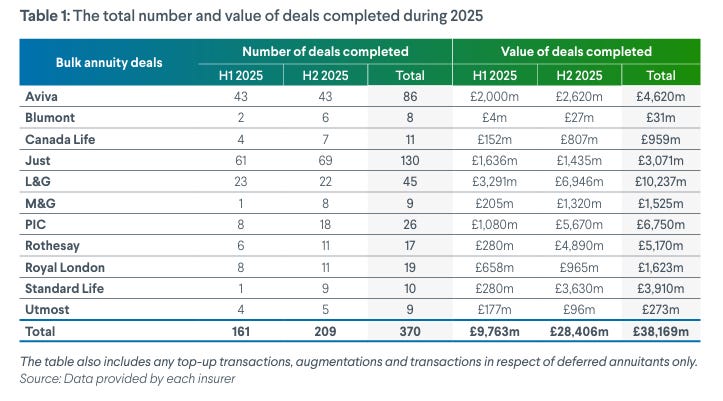
Source: Hymans Robertson Bulk annuity and longevity hedging report - H2 2025
By contrast, the largest transactions remain fewer in number. The market saw at least 15 buy-ins of £500m or more in 2025. This is the part of the market where the new entrants’ asset capabilities could have the greatest impact over time.
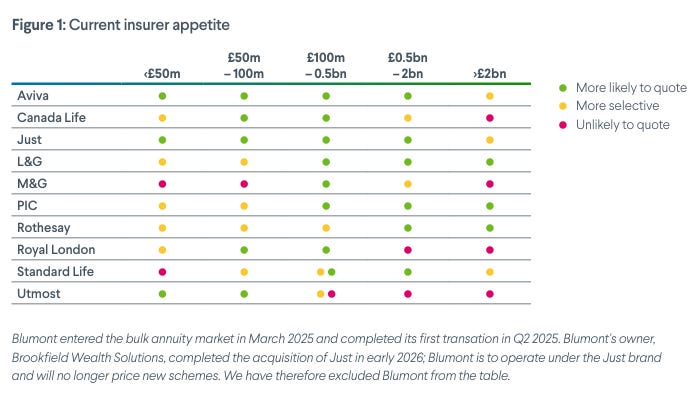
Source: Hymans Robertson Bulk annuity and longevity hedging report - H2 2025
More capital, combined with stronger asset capabilities, will make pricing more competitive at the margin and increase the importance of what happens after the deal is written. Asset returns are becoming a more important driver of overall profitability than the terms agreed at inception.
I do not think this is a market where returns collapse; the regulatory framework and capital requirements provide a degree of discipline. It is, however, clearly becoming a more demanding environment in which to operate.
The differentiator has moved to the asset side
The most important shift is where value is created.
Historically, BPA transactions were competed on underwriting, pricing and balance sheet capacity. Increasingly, the differentiator is the ability to generate returns on the assets backing those liabilities, which is a fundamentally different type of competition. It favours business models that can originate, structure and manage assets more effectively within the same regulatory constraints.
The underwriting capability across the market is well established. The differentiation is moving to the asset side, and that is precisely where Brookfield, Apollo and Blackstone have their strongest credentials.
What this means for listed insurers
I do not think listed insurers are going to be competed out of this market. The opportunity is too large and the pipeline too deep for that outcome.
I do think the competitive environment has shifted in a way that demands a response. The average premium per BPA transaction in 2025 was £103m, but that average conceals enormous variation. Standard Life had the highest average deal size at £391m, followed by Rothesay at £304m and Legal & General at £227m. At the other end, Just Group dominated the market by transaction count (around 35% of all deals) but wrote only around 8% of total premiums, with an average deal size well below the market average. Legal & General, by contrast, completed roughly 12% of transactions but captured around 27% of premiums.
These are fundamentally different business models operating in the same market. Legal & General and Standard Life are competing for larger mandates, while Just Group is processing volume at the small end. Aviva sits somewhere in between, with around 23% of transactions and 12% of premiums.
I expect one consequence of the change of ownership is that both Just Group and PIC may increase their average deal size. Brookfield and Apollo bring asset origination capabilities that are most valuable on larger, more complex transactions, and both new owners will have a strong incentive to deploy their investment platforms at scale. PIC already skews towards larger deals; Just Group, which has historically dominated the sub-£50m segment, may shift its mix towards bigger mandates over time. If that happens, it would ease competitive pressure at the smaller end of the market, precisely the segment where the listed players and newer entrants are most active.
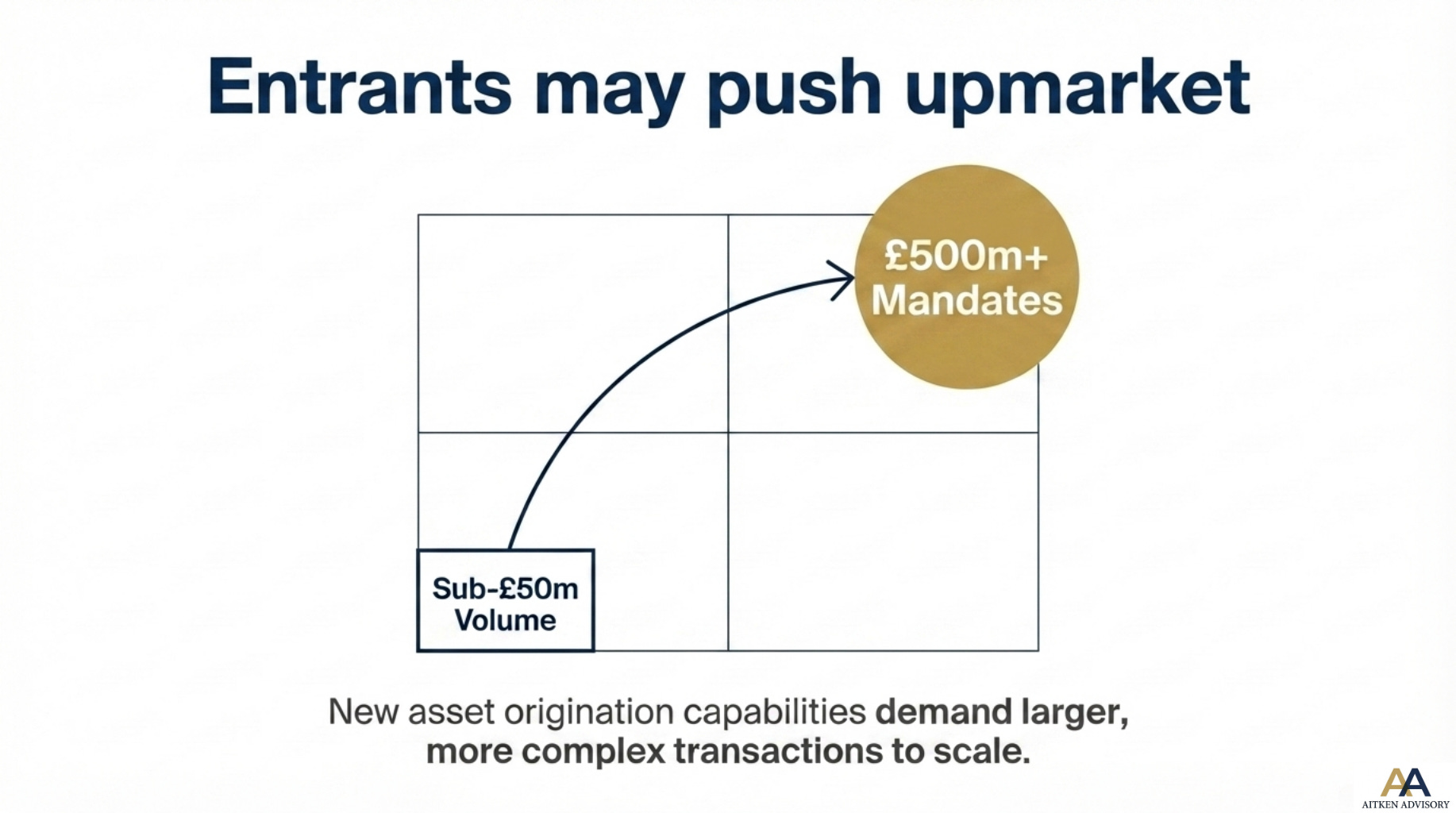
The likely outcome is a more segmented market, where different models coexist. Some players will lean more heavily into asset origination and integration, while others will focus on discipline and execution. There is room for both approaches, but the bar has clearly been raised.
The Hidden Upside of More Competition
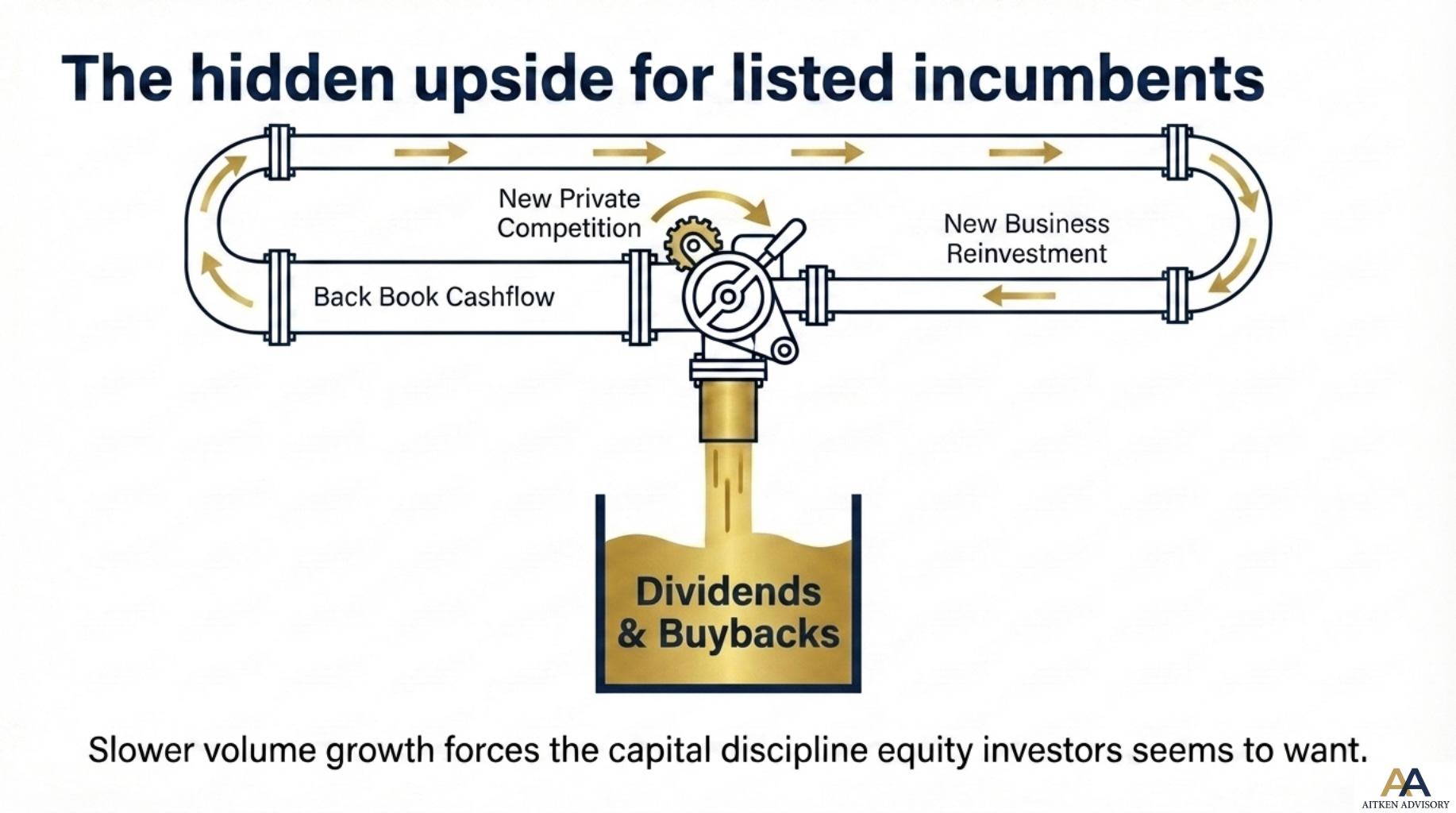
There is also a less obvious consequence of increased competition that could actually improve the investment case for the listed players. One of the persistent complaints from public equity investors has been the lack of visible free cash flow from listed UK life insurers. The reason is straightforward: writing new bulk annuity business is capital-intensive, and historically the cash generated from back books has been recycled straight into new business, never reaching shareholders.
If increased competition slows new business volumes for the listed writers, that capital-hungry reinvestment cycle eases. The back books continue to generate cash regardless, the liabilities ‘run off’ predictably over decades. More of that cash flow becomes available for dividends and buybacks, which is exactly what public equity investors want. The irony is that the arrival of private capital competitors, which the market instinctively views as negative, could actually force the kind of capital discipline that makes the listed insurers more attractive to their own shareholders.
If the valuation gap persists, more bids will follow
If these businesses are attractive to private capital, it is hard to argue that the Athora/PIC and Brookfield/Just transactions will be the last. Indeed, Utmost’s life and pensions business was acquired by US-based JAB Insurance shortly before Christmas 2025, representing a third transaction in quick succession.
BPA platforms are not easy to build. They require regulatory approval, operational infrastructure, long-established relationships with employee benefit consultants and pension fund trustees, and a track record that takes years to develop, which means acquiring an existing platform provides immediate access to all of that, along with the liabilities and assets that sit behind it.
At the same time, listed UK life insurers continue to trade at valuations that do not fully reflect the long-term economics of the business, particularly when viewed through an asset-driven lens. Brookfield paid about 1.1x unrestricted Tier 1 own funds for Just Group, a meaningful premium to where the stock had traded for years. Put those two things together, and further approaches look entirely plausible.
Enough for everyone, provided the incumbents raise their game
My view is that this is not a disruptive moment, but it is an important one.
The bulk annuity market remains, in my view, one of the most attractive structural growth areas in European insurance, a view I have held consistently for more than a decade. It has grown by over 20% per annum by transaction count, which I believe is the most meaningful measure given that rising interest rates can distort reported deal volumes. It has genuine duration and generates value over time in a way that public markets have often underappreciated. The fact that Brookfield, Apollo and Blackstone have all made significant commitments to this market within a matter of months is powerful validation of that assessment.
What has changed is the level and type of competition. New owners bring different capabilities, particularly on the asset side, and that will make the market more competitive for larger transactions while placing more emphasis on asset execution.
I do not think this becomes a zero-sum market where incumbents are pushed out, because the opportunity is simply too large for that. With £350bn to £550bn of projected BPA volumes over the coming decade, there is more than enough business for well-positioned listed and private players alike. Instead, I expect we see a market with more capital, more participants and clearer differentiation between business models.
The question is no longer whether bulk annuities are attractive, but who captures the value over the next phase of the market.
Want a deeper dive on UK life insurers, annuity balance sheets, and why markets often misprice them in stress? That is the core theme of my book, Breaking Down the Insurance Black Box.
Gordon Aitken runs Aitken Advisory, providing strategic advice on UK and European life insurers and pension funds. I work with investors, insurers and advisers on transactions, capital strategy and market positioning. If you would like to discuss a potential engagement, please get in touch.
Disclaimer
The content of this publication reflects my personal views only and is provided for information purposes. It does not constitute investment advice or investment research, and I am not acting in the capacity of an investment adviser. I own shares in some of the companies mentioned. Readers should carry out their own analysis or seek professional advice before making any financial decisions.
Gordon, a great piece on the “Black Box.”
Private capital is not disrupting insurance; it is exposing it.
Asset managers are buying the wrapper and confronting a structural issue that has existed for decades: underwriting treated as the “core” and investments as “support.” In reality, the investment engine was carrying risks nobody fully owned.
The last three years - rates, MTM losses, private credit, liquidity stress- have made that visible.
The issue is ownership.
- Underwriting decides the entry price and risk
- Investments decide the asset backing
- The balance sheet absorbs the outcome
No one person or process owned the full decision.
Private capital integrates this better - treating liability and asset as a single trade.
It doesn’t remove the risk. It concentrates it.
The real question isn’t pricing. It’s whether incumbents can fix fragmented decision-making before the new owners out-originate them.
Great blog. It’s hard not to conclude that someone like KKR must be looking at the UK market and checking out aviva or L&G, and trying to figure out how to get involved
especially given the what they have been doing in Asia